Wednesday, 10 August 2011

What we plant in the soil of contemplation, we shall reap in the harvest of action.

My first thought on seeing ArenaNet’s reveal of the Sylvari 2.0 – Now with 50% more foliage!, was that they certainly passed the international standard cosplay checklist:

  • Opportunity to paint skin weird colours? Check.
  • Liberal use of liquid latex a must? Check.
  • Option to expose varying levels of said latexed/painted flesh, up to and including ‘disturbing’? Check.
  • Costume design that has ‘we’re going to need a bigger sewing machine’ written all over it? Check.
  • Compulsory requirement to stick foam shapes and bits of Plasticine to one’s head? Check.
  • Is it a hat or is it hair? Check.
  • Tattoos? Check.
  • Crazy luminous tattoos that someone is going to use as an excuse to make their nipples glow in the dark? Check.
  • Contact lenses considered mandatory? Check.
  • Potential for hormone colliding crossplay? Check.
  • Eschews traditional human-style gender roles? Check.

So yes, it’s all looking good on the cosplay front. And back. But mainly the front. Must be those bioluminescent nipple tattoos.

Reading a bit of background to the Sylvari, it seems that ArenaNet are trying to present a race which is a little bit alien, a little bit fae, a foundation usually filled by elves in traditional fantasy RPGs. Sadly few designers have managed to portray elves as anything more than an aloof sect of infinitely skilled disdainful know-it-alls. An elf race should give the opportunity to really explore that gulf which experience provides, that juxtaposition of a human-like being with the alien nature of one who has witnessed countless centuries, but it rarely seems to be expressed in games other than through that cunning narrative device of an arched eyebrow and a slightly condescending tone of voice. ArenaNet have branched off from this approach, taking the alien nature and layering it on to a budding young race, one that is inexperienced, although not naive. The Sylvari connection to The Dream will surely resonate with anyone who has enjoyed White Wolf’s Changeling: The Dreaming, and the second Sylvari design keystone of ‘curiosity’ can only help play to this fae feeling. Again though, as with the comparison to elves, the Sylvari differ from the fae in that they are a young race, and therefore there isn’t the unwieldy baggage of a millennia of complex history to weigh the players down as they travel through the world. There’s certainly plenty to like about this race, and more than enough to differentiate it substantially from the other races the game provides; much as I felt about the Undead in World of Warcraft, there’s something about the Sylvari that seems to set them apart from the other warring races. Although the other races in World of Warcraft and Guild Wars 2 all have a look and feel that differentiates them from one another, they still feel as though they come from the same basic stock, whereas the Undead and Sylvari have that slightly unknowable quality to them.

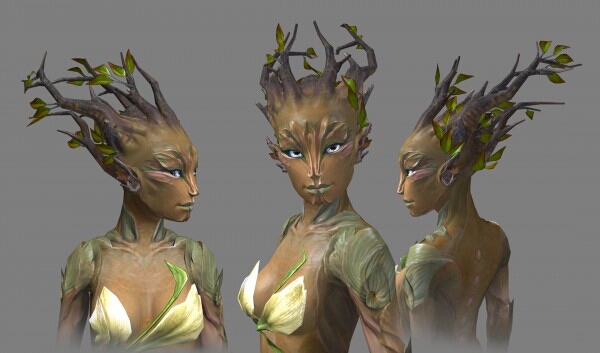
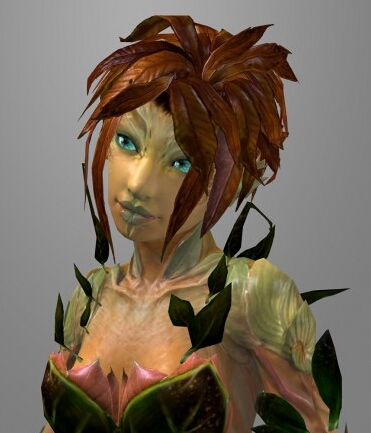
As for the physical design of the race, well we’re on the second edition [probably should avoid book metaphors, tree people may find books slightly offensive – Ed.], and it’s always going to be a subjective issue. In my view I think they still haven’t gone far enough towards the alien end of the scale, but it’s always going to be difficult to tell from a select number of screenshots. Certainly our friend to the left with the tree branch hair is approaching that level, whereas the one below right is definitely ticking all the boxes on the Foxy Chick With Leaf Hair cosplay checklist. Again though, there may well be variety in the character creation so that both options are viable, and there will almost certainly be people who like the ideals of the Sylvari, but to whom a strange alien appearance doesn’t appeal. Not to mention it’s a tricky scale on which to balance: at one end you have the Poison Ivy look, which is essentially a Playboy model with green lipstick and body suit, and at the other end you have World of Warcraft’s druid Tree of Life form, certainly a far more alien sentient plant design, but perhaps far less appealing to the majority of players. So I imagine ArenaNet’s Kristen Perry slid up and down this scale (having seen pictures of the inside of ArenaNet’s studio, I wouldn’t put it past them to have created a giant fun-park scale which everyone could slide up and down on tea trays) trying to balance a requirement for alien humanoid flora against a desire to still present an attractive aesthetic design; it’s a design brief where I imagine H.R. Giger would have had a field day.

Certainly the current Sylvari incarnation is an improvement over the original design, and it manages to find a place on the design scale that avoids the horrors of both Tree of Life Form in a Bikini and Naked Human Wrapped in Stinging Nettles, something for which I’m sure cosplayers and cosplay admirers everywhere will be grateful.

Monday, 8 August 2011

Character is like a tree and reputation like a shadow.

From now on, before I start playing a new MMO, my character is going to write a linkedin system, using papyrus punched with their teeth if they have to, and hand it out to every NPC in the game.

Thus, when my character approaches a new faction, having adventured for years, with a hundred levels under their belt, the defeat of countless potentially world-ending villains, the rescue of multifarious powerless persons, the destruction of numerous evil relics of infinite power, the overthrowing of divers despotic regimes, the prevention of multitudinous cataclysmic events across both time and space, and a dedication to the slaughter of wildlife that would give a T-rex indigestion at the mere thought, they can point the snooty NPC –who wants my character to collect badger turds for faction reputation before they’ll speak to them properly– to their linkedin profile, which reports a network of over fifty thousand satisfied NPCs who were unable to save their own sorry arses, and a reputation of AAAA++ Would Definitely Have This Hero Save Our Town Again.

Then my character would take the bag of badger bum blops and empty it over the NPC’s head, telling them that it’s their own damn porridge so they can use their own damned spoon, before wandering off and finding a faction that willingly accepts an offer of aid.

Friday, 5 August 2011

We dance when e'er we're able.

“Finally, no matter how fantastic a game’s music is, when you hear the same music for the thousandth time, you start wanting to change things up a bit. Many players will simply turn the game music off and play their own collections. The problem is that an external music player has no context as to what’s going on in-game. Guild Wars 2 will offer a solution for this as well. We’re giving players the option of choosing external music playlists that the game’s audio engine will use as a replacement for the default in-game music. Players can choose different playlists for background ambience and battle music, for instance. Additionally, when appropriate, such as during cinematics, the game can revert back to in-game music temporarily to give the best possible cinematic experience, then resume the custom playlist when it’s done.”

ArenaNet continue their series of audio design diaries with an interesting piece detailing some of the new features they’ll be adding to the audio system for Guild Wars 2.

As a player of MMOs who generally turns the sound off after a while, I have to say that I’m quite excited at the prospect of being able to tweak the music score when the mood takes me. Jeremy Soule’s soundtracks are always a delight, but still, there are nevertheless going to be days when you just feel the urge to listen to something a bit different.

It’s fun that (they claim) you can pick your own selection of ambient and battle music to be played at the appropriate time determined by the game system, and I’m already considering the excellent possibilities that such a system would allow: battle music set to Yakety Sax, the Ying Tong Song or the The Tra La La Song? How about a hook for when you inevitably run away from combat or attempt to avoid crap mobstacles, for which there can only be one song to bravely throw-in the sponge to. Then there’s the possibility to switch things up a bit, having songs such as Iron Maiden’s Run for the Hills as ambient music, while Eine kleine Nachtmusik tentatively tinkles into your ears whenever an epic battle breaks out.

Once again ArenaNet are making all the right noises, where the overarching impression I take away from their media presentations is one of ‘careful consideration of the issues facing players of MMOs’; it’s encouraging, yet my enthusiasm still can’t help but be tempered by the fact that we’ve heard asseverations like these in the MMO space before, where the resultant game did not seem to deliver anything like the promises of its promoters.

In war we’re tough and able,
Quite indefatigable.
Between our quests we sequin vests and impersonate Clark Gable.

Thursday, 4 August 2011

Thought for the day

Sophisticated game engines that blur the lines between cutscenes, scripted sequences and regular gameplay can be a powerful tool for increased immersion. It can be irritating when control is taken away from you and you’re forced to observe something while frozen in fear, or through the unbreakable window of a locked room, but at least it’s preferable to the illusion of interaction when there’s only one possible outcome…

“Right young Geoffrey, let’s make up a story together! What would you like to hear a story about?”

“Dragons!”

“You’d like a story about chartered accountants? Excellent! Once there was a chartered accountant; what do you think his name should be?”

“Lancelot!”

“No, Geoff, that’s wrong, he’s called Nigel. Once there was a chartered accountant called Nigel, who lived in…”

“Outer Space!”

“Don’t be silly, Geoff, Outer Space has no accredited institutions that can confer chartered status. No; once there was a chartered accountant called Nigel, who lived in a medium sized village in the Thames Valley area within convenient commuting distance of the headquarters of several multinationals. One day, Nigel learned that…”

“He had magical powers!”

“NO, GEOFFREY! WRONG! Now we’re going to have to back to the beginning of the story, and try again until you give the correct answer. You can look it up in the Wiki here if you like. Let’s try again; once there was a chartered accountant called Nigel, who lived in a medium sized village in the Thames Valley area within convenient commuting distance of the headquarters of several multinationals. One day, Nigel learned that…”

Wednesday, 3 August 2011

I even think that sentimentally I am disposed to harmony.

“At ArenaNet, we’re serious about audio. This week we’re going to take a look behind the scenes at the Audio Team that has been working so hard to create a compelling soundscape for Guild Wars 2.”

So begins ArenaNet’s latest blog post looking behind the scenes at various production elements of the game, this time concerning audio.

It isn’t really necessary though. I mean, don’t get me wrong, it’s splendid to learn that attention to detail is important to ArenaNet throughout all systems of their game, and the insight provided as to how they achieve their results is fascinating. However, I can’t help but feel that this particular effort is a little wasted, because as long as the haunting orchestral chanting of the traditional Guild Wars theme comes blaring out of my speakers (with the option to turn the volume up to Over 9000) as soon as I launch the game, drowning out all else, and never stopping until I logout, then I’ll be perfectly content; the rest of the game’s audio could consist of ArenaNet engineers performing interpretive armpit farts, I’m fairly sure I wouldn’t notice.

Just give me that song and my soul is sold.

Tuesday, 2 August 2011

Link it to the world. Link it to yourself.

As is the way in this blogosphere of ours, a number of other blogs have already reported on the recently released initial details of StoryBricks, an RP storytelling game programming framework which is in development by the fine folks at Namaste, a company who ‘Just want to play’, something which probably makes developing a game somewhat difficult

“Let’s make a game!”

“Great!”

“Actually, I just want to play.”

“Ooo, I like that idea better!”

“Let’s just play a game!”

“Hooray!”

Nevertheless, Namaste’s MMO Wizard, Brian Green, and Cat Herder, Kelly Heckman, did manage to restrain themselves from playing for long enough to sit down with KiaSA and give us an introduction to the concept of StoryBricks, and show us the current prototypal realisation of Namaste’s ideas: ideas which they are demonstrating at Gen Con Indy right now!
NOTE: Values of ‘right now’ may vary depending on when you’re reading this. If, for example, it is the year 2037, then they probably aren’t demonstrating StoryBricks ‘right now’, and this would probably be of little concern to you anyway, since you’re actually looking for a way to rid the Earth of its current overlords, the Xzibliks of Pangifran VII (Hint: Custard Cream allergy).

Perhaps the most important thing that we took away from the impromptu meeting did not actually concern the game or its concept –which is nevertheless exciting and interesting and packed with promise and potential– but instead revolved around the philosophy the company is taking in developing their game. Namaste have decided to take their newborn out to show the world. As with any doting parents, the concern is that others may see just another amorphous pink blob making some noise, but their overriding hope is that sensible people will look past the fresh, near-embryonic packaging, and instead see the potential contained within this little bundle, a bundle which will grow and adapt and strengthen over its years of development into something special. Now we’re not entirely known for being sensible here at KiaSA, and yet even we could see the potential in their current concept.

Namaste’s intention seems to favour feedback from their target market from day one, or as close to ‘day one’ as you can get without your presentation consisting of a pencil and a piece of paper with the words MAKING A GAME scribbled across the top. So if you’re reading this, and it’s not the year 2037 but slightly closer to 2011, you can go to Gen Con Indy this week and see for yourselves what Namaste is working on, just a few months into their development cycle. They’re garnering feedback from those people whom they hope will want to play with StoryBricks, a development concept which seems alien in the world of game making. I mean, where are the secrets? The exclusives? The ‘Could We Just?’s and the ‘Ooo, Sorry We Can’t Yet!’s? Where’s the dangling of screenshots of half a tree next to a house, with the implication that ‘This could be somewhere exciting in the game!’ but with caveat that ‘It probably isn’t’. Instead what we have is, well… what we have. It’s the current development build as they work through their core ideas, which they then bring to you, the players, and ask ‘Is this what you would want? How could we make it better for you?’

Refreshing.

Don’t misunderstand: they have solid plans, ideas and goals, this is not a fishing expedition with dynamite, they are simply testing the waters and seeing which bait is most likely to get players to bite, metaphorically speaking, of course (KiaSA has never been to Gen Con, but we hear that some of those free-form RPG sessions can get pretty heated).

Who is this target market of players that they are currently reaching out to? Well, initially it seems it’s the storytelling RPG demographic, the White Wolf and Dungeons & Dragons crowd; it’s those people who currently build interactive stories with pens and paper, who might like to have an intuitive and fun way to build their stories within a 3D virtual space, where NPC AI reacts to the players based on a framework or back-story that has been planned and implemented by the story’s creator using StoryBricks.

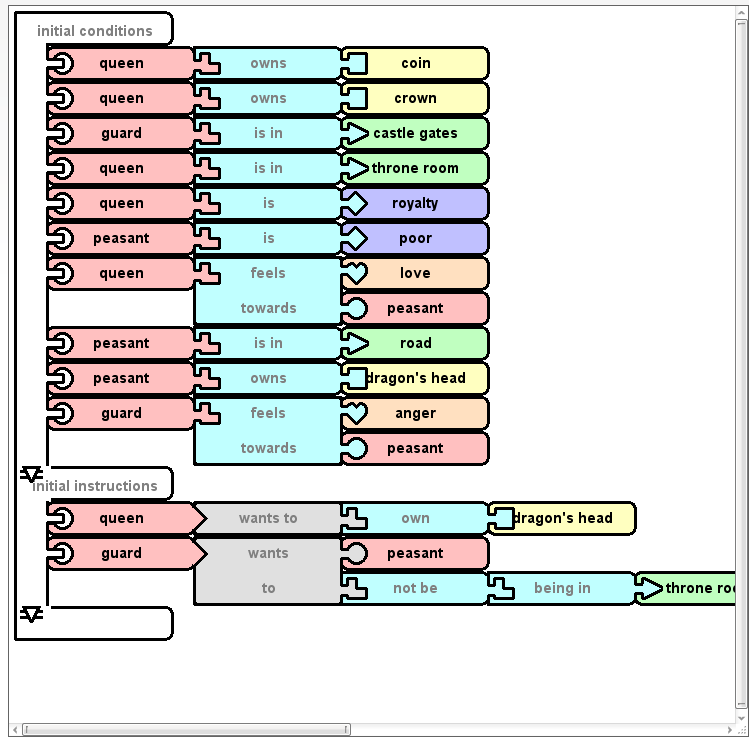
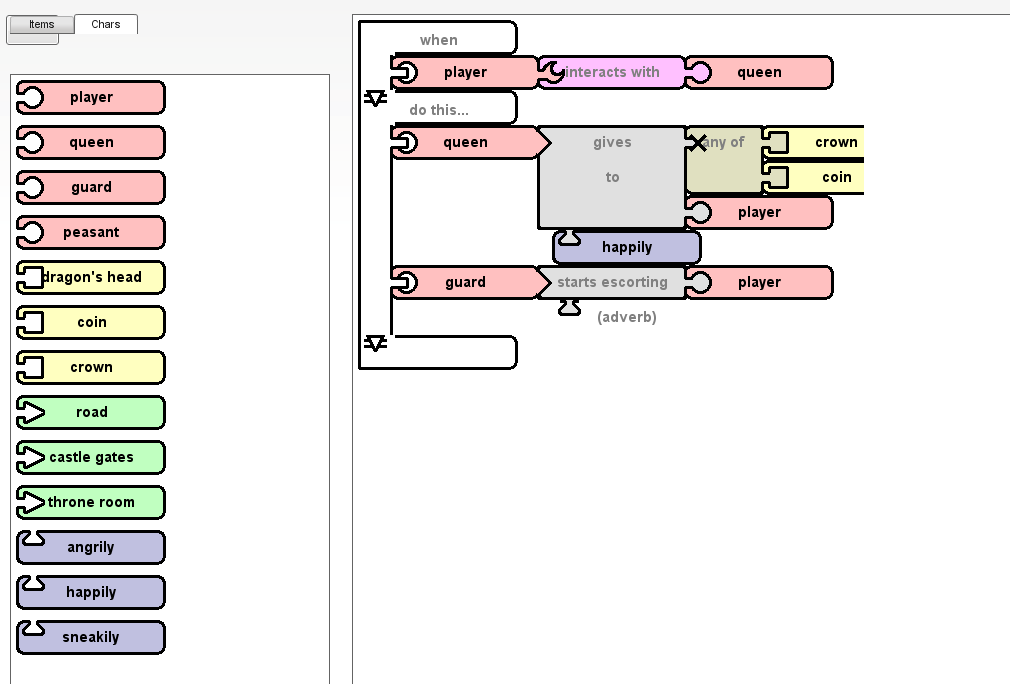
But what is StoryBricks? In its current form –and remember that everything is in very early development: a state of flux that rivals primordial oceans, but with similar prospects for creating exciting new things– StoryBricks is a system which allows gamers to program their own stories. It’s clear that this newborn has indirectly inherited from a lineage that includes systems such as MIT’s Scratch and, more loosely, Lego Mindstorms, the latter of which certain sprang to mind because one half of KiaSA has recently been working on a project that uses National Instruments’ LabView. These graphical systems are different concepts from what a text-based coder is used to, but ‘algorithms is algorithms’ as Oscar Wilde once said to Ada Lovelace as they successfully fought off another wave of Neptunian Robomatons (we really must get around to writing that story), and visual programming systems such as these are great enablers for non-coders to, quite literally, plug and play their way into programming. The story programming is linked to objects and NPCs in a 3D game world, which operates much like your standard RPG, except NPC AI is determined by the rules programmed into the story framework. You play Neverwinter Nights, say, but the NPCs’ AI reacts to the players, and indeed other NPCs, based on their StoryBrick programming, such that emergent game-play is a real possibility.

Here’s an example based on our impression of the game from the demonstration. Consider a thief at an inn who has an object which the players need for their quest. In most MMOs the players would simply stab the thief, loot the item, perhaps have to wait for the thief to respawn another seven times so each member of the party could stab him and loot the item, before handing it in for some XP. In StoryBricks the… Brickmaster? may well have programmed the local guard to be ‘wary’ of the players, such that as they approach the thief the AI determines that the guard will watch the players and intercept them if they attack. The players will witness the guards distrust through emotes. The players may discover, however, that the bartender of the inn is ‘resentful towards’ the thief (perhaps the thief has a large tab he hasn’t settled; such back-story would be available to the players as per the Brickmaster’s story framework) and that with a little persuasion and passing of coin, they can get the bartender to ‘place sedative’ into the thief’s next drink. With the thief unconscious, the player’s could pickpocket the thief without rousing the guard’s suspicions.

Parallels can clearly be drawn with other systems for player created content, such as Second Life, LittleBigPlanet and City of Heroes’ Mission Architect, but where those games concentrate on giving players options to build objects, levels and missions, StoryBricks is aimed at allowing the players to build a story, creating something more akin to a Dungeons & Dragons module for players to experience, where the work of the GM in running NPCs is subsumed into the module framework itself.

It’s certainly an ambitious and interesting concept, and one that should be easy and exciting to follow in the coming months if Namaste’s current honest and open development style continues. KiaSA will definitely be keen to give feedback whenever possible, starting with our current observation that although StoryBricks such as ‘likes’, ‘hates’, ‘owns’ and ‘gives’ are all well and good, there’s certainly a market for more KiaSAble StoryBricks, such as ‘splungthrust’, ‘sternly clenched’, ‘panicked squassation’ and ‘ejected sardanapalian spumescene resulting from cheeseboard indecision’. On second thoughts those might be a bit too specific for general use, perhaps we could license the option for a future expansion pack.
Monday, 1 August 2011

To many people holidays are not voyages of discovery, but a ritual of reassurance.

My week of holiday over, it’s back to the grindstone for me; as well as getting back to playing MMOs I should probably return to work too. I managed a week away without MMOs quite admirably all things considered, and the palpitations were barely noticeable by the end of the third day. I attribute this to my quick development of a survival strategy to deal with the oppressive fresh air and interminable rest and relaxation the holiday resort provided, and so I present here a few tips and tricks to avoid MMO withdrawal while being forced to experience the ghastliness that is moderate sunlight, forest scenery, and light exercise.

If you have children, make them collect things.

My three-year-old daughter has a fascination with pine cones, something which becomes somewhat of an obsession when presented with a forest packed to the canopy with conifers. I made the most of the situation by setting her tasks to collect certain numbers of pine cones and return them to me. When she returned with the correct number I would offer her the choice of a plastic sword or an item of clothing from her suitcase, the latter of which she quickly learned could be equipped in order to improve her resistance to elemental damage. If she brought me an incorrect number of pine cones, I would either ignore her entirely, or incessantly repeat the same nonsensical sentence to her until she went away and collected the correct number. As the holiday progressed I found that I could increase the complexity of the task to keep things interesting, asking her to collect only pine cones of a certain size, for example. Of course, any pine cones that she collected prior to me assigning the task were ineligible for submission. Eventually, however, pine cone collection became tiresome to us both, and so I determined to set her more challenging tasks. After the angry phone call from the petting zoo asking if I was related to the small child with the plastic sword who was attacking the pigs, I decided to stick with creatures that could be found in the surrounding forest; unfortunately she never did manage to catch a wolf, despite several nights alone in the forest searching for them. I found the trick to convincing her to undertake the more extreme tasks was a suitable reward, with access to her mother and food curiously being the best motivators, while MMO staples such as gold and ‘character building experience’ seemed not to provide any incentive at all.

Create your own Fed Ex quest

Write a letter asking the recipient if they would like a bag of obscure sweets from the place you intend to visit on holiday. Seal the letter in an envelope and address it to a friend who is not going on holiday with you. Take the letter with you on holiday, and at some point during the vacation hand it to your partner. Your partner will look at it, tell you it’s addressed to your friend back home, and that you should probably give it to them. Upon returning home give the letter to your friend, whereupon they will open the letter and tell you that, yes, they would like a bag of obscure sweets from the holiday location you just returned from. Keep the letter until the next time you return to that holiday destination, at which point you can then buy the sweets. Give the sweets to your friend upon your return: quest complete!

Don’t forget to loot everything

Be sure to wander in to every holiday villa you come across and take all the items you think you might be able to sell for a quick profit. Don’t mind any people who you may stumble across while rummaging through the place, they should ignore you. Be warned, however, that the occupants might try to tell you their life story and burden you with a tale of woe; if this looks likely, make a run for the exit, grabbing anything you can from the table by the door on the way out.
.
Also make sure to loot any corpses you see. Most combat seems to take place primarily on sandy beach areas where you’ll find many corpses laid out on death shrouds, being dried in the mid-morning sun ready for mummification. Usually these corpses have plenty of loot left in their bags and satchels, but don’t under any circumstances try to acquire their plate-mail bikinis: some curse binds the armour to them even in the after life, and they will rise up from the dead and immediately aggro.

Holiday mail

Don’t forget when travelling abroad that many foreign places –despite being scary and full of foreigners– still exhibit some of the basics of modern society, such as rudimentary mail systems. Be sure to look for mailboxes and take the opportunity to dance on or around them wherever you can. It’s often difficult to explain a full suit of oversized plate armour to a customs official, so it’s best to improvise an impressive legendary outfit when you reach your holiday destination: putting on a bikini and covering giant palm leaves in silver glitter then taping them to your shoulders makes an excellent approximation for epic plate armour, for example. I didn’t have time to think of any outfit ideas for females however, sorry.

Consider crafting

Find a nice open space on a nearby beach and, using a small bucket, begin building rudimentary sandcastles. Repeat this process until you have at least three hundred and fifty tiny sandcastles or you have filled the beach, whichever comes first. Once complete, quickly rake all the sandcastles back into the beach before anyone can observe your work, and then start again, only with a slightly larger bucket. For an authentic experience increase the number of sandcastles you require by a factor of 1.2 each time, and place an arbitrary restriction on the creation of each castle, such as requiring a shell for the front door, or a flag made from a near-extinct flower only found in a single isolated location three hundred miles away from your current position.

Hearthstone emulation

At the end of the holiday, simply get in the passenger seat of the car, quickly go to sleep and let your partner drive the many hundreds of miles home through nightmarish holiday traffic. When you awake, however, it will be back at your house, and it will appear from your perspective that you instantaneously transported there! Any budding Paladins may want to take a roll of bubble wrap with them in which to encase themselves before the journey.