Sunday, 13 May 2012

Thought for the day.

Plus ça change: I remember how any new MMO that launched would have a General Chat channel filled with proclamations of how much better the game was than World of Warcraft. I’ve been in two new MMOs recently, and I’ve seen none of that usual banter.

Plus c’est la même chose: Now everyone is jabbering on about how much better the game is than Star Wars: The Old Republic.

Friday, 11 May 2012

A noble craft, and also a most lively!

One of the nifty![TM] features I’ve experienced in a couple of recent MMOs is the inclusion of crafting in other aspects of the game, outside of merely producing five million worthless trinkets to be sold to a vendor, before being able to finally produce the epic quality Toe Ring of Time, which gives your character a best-in-slot 0.01% boost in DPS over anything you can acquire in the levelling game, which nobody will ever be aware of, and which will be replaced by the first piece of end-game dungeon loot that drops.

The first of these is within Star Wars: The Old Republic. Crafting skills in SWTOR can be used to bypass areas of the game’s instanced dungeons – flashpoints. I love the idea of this, the fact that being a crafter of a certain type actually means something. What I particularly liked was that access to a shortcut or bonus area was themed towards the type of crafter who could negotiate that access. A set of tunnels which take the players around several corridors of heavily armed guards might be filled with a poisonous gas, and thus a Biochem specialist would be required to repair the filtration system which would neutralise the obstacle; someone versed in Cybertech might be able to reactivate a facility’s sentry droids, turning them against the mobstacles that litter the paths through the instance. It’s not essential to have a crafter of a certain type along, all the crafting activated events are usually bonuses and shortcuts which make the job easier, and not requisites for successfully completing the instance. I think BioWare struck a nice balance between players getting a bonus for having a certain crafting class, without it being compulsory to ‘bring along a crafter’. M’colleague informs me that, alas, this design featured less heavily in the later flashpoints he experienced.

It was whilst playing TERA that I was reminded of SWTOR’s subtle mechanic for craftily encouraging crafting. In TERA, each crafting node will grant a modest buff when harvested. It seems that these buffs are random, or perhaps tied to the type of node harvested, but by gathering from a number of nodes you can quickly find yourself with a considerable stack of buffs, which although modest in their own right, can result in quite a boost to your combat prowess when their effects are combined. I like this system better than that provided in World of Warcraft, where the gathering profession itself gives you a permanent boost to a stat, or a utility ability, because WoW’s system just becomes another item on the Great Min-Max List (‘Has optimal gathering profession to boost combat prowess?’), whereas TERA’s system temporarily rewards you for the act of gathering itself; for crafters or auction house wranglers this is a non-issue, but for everyone else there’s now a reason to get involved in gathering, and hey, if you have all those crafting materials in your inventory, why not try putting something together? Incidental crafting –which may in turn lead a player to discover a deeper love of crafting than they would have otherwise imagined– is a nice side benefit of such a system.

I really like this blending of boundaries, where consideration is given to the fact that gathering from crafting nodes doesn’t have to exclusively produce materials for crafting, and where crafting doesn’t have to correspond purely to churning out equipment. It draws those mechanics into the main combat-driven system, smudges the edges, blurs the demarcations, but does so by giving modest bonuses to those players who gave it a try, not by punishing those who didn’t.

I’d certainly like to see more features like these in future MMOs, because I feel that it’s very much this sort of parallel design that helps to make a game feel like a world, rather than a series of independent mechanical systems.

Thursday, 10 May 2012

What you might see as depravity is, to me, just another aspect of the human condition.

Having reached level twelve and finished the quests on the introductory Island of Dawn, I took the Pegasus flight to the major city of Velika. Situated in Southern Arun, this is the seat of the Valkyon Federation, a coalition of all the civilised races of the land against the invading Argons. The flight into the city was stunning, as my mount ‘rung upon the rein of a wimpling wing In his ecstasy! then off, off forth on swing, As a skate’s heel sweeps smooth on a bow-bend’, wending its way around the blanket of countryside rolled-up around the city’s waist, I could only marvel at the exquisiteness of the environs. There’s no doubt that these worlds which we inhabit have developed, in graphical terms, to the point where it seems as though one could reach through that lambent mirror sat upon the desk, and grasp the infinite pixels of possibility which it reflects.

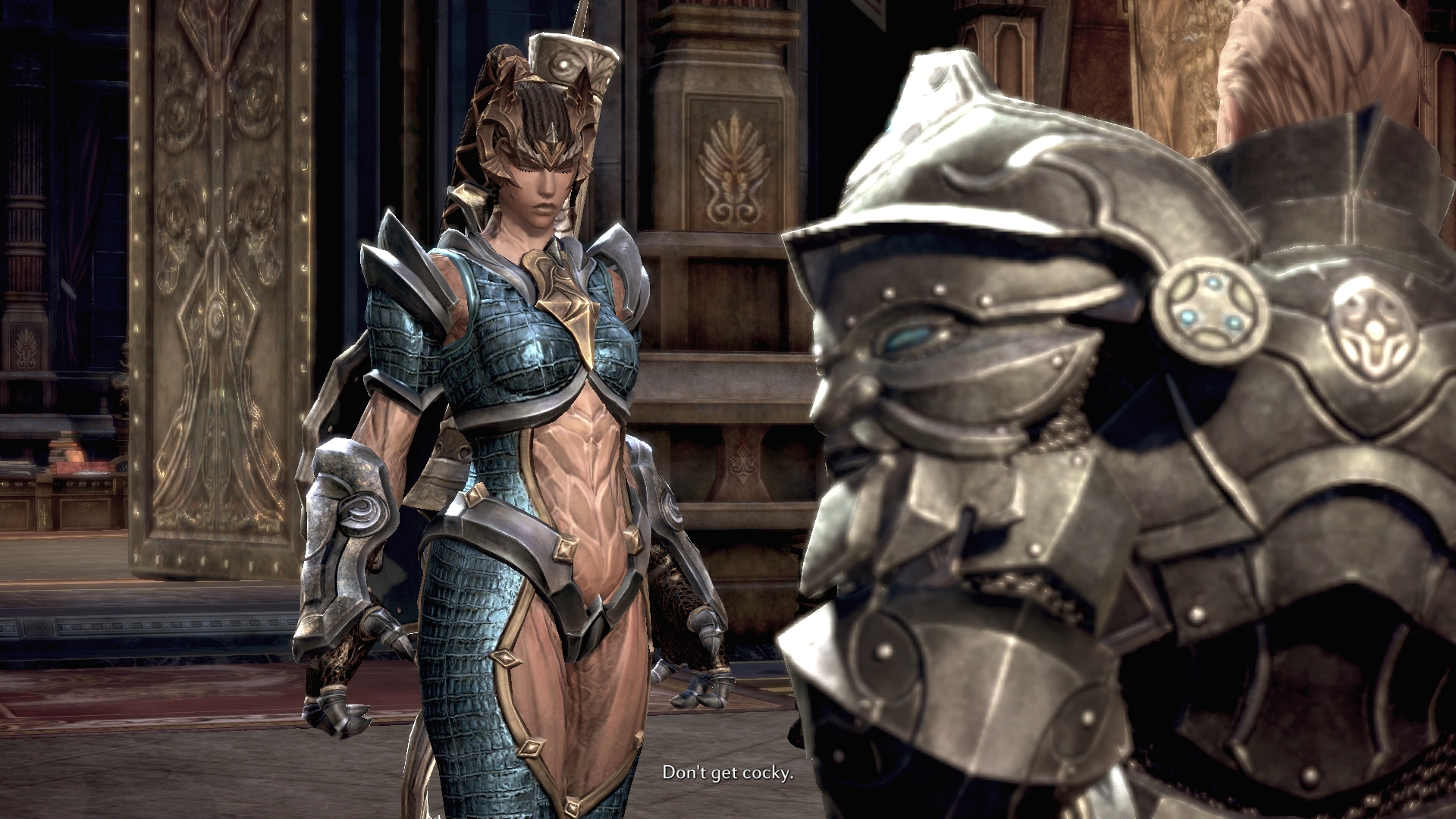
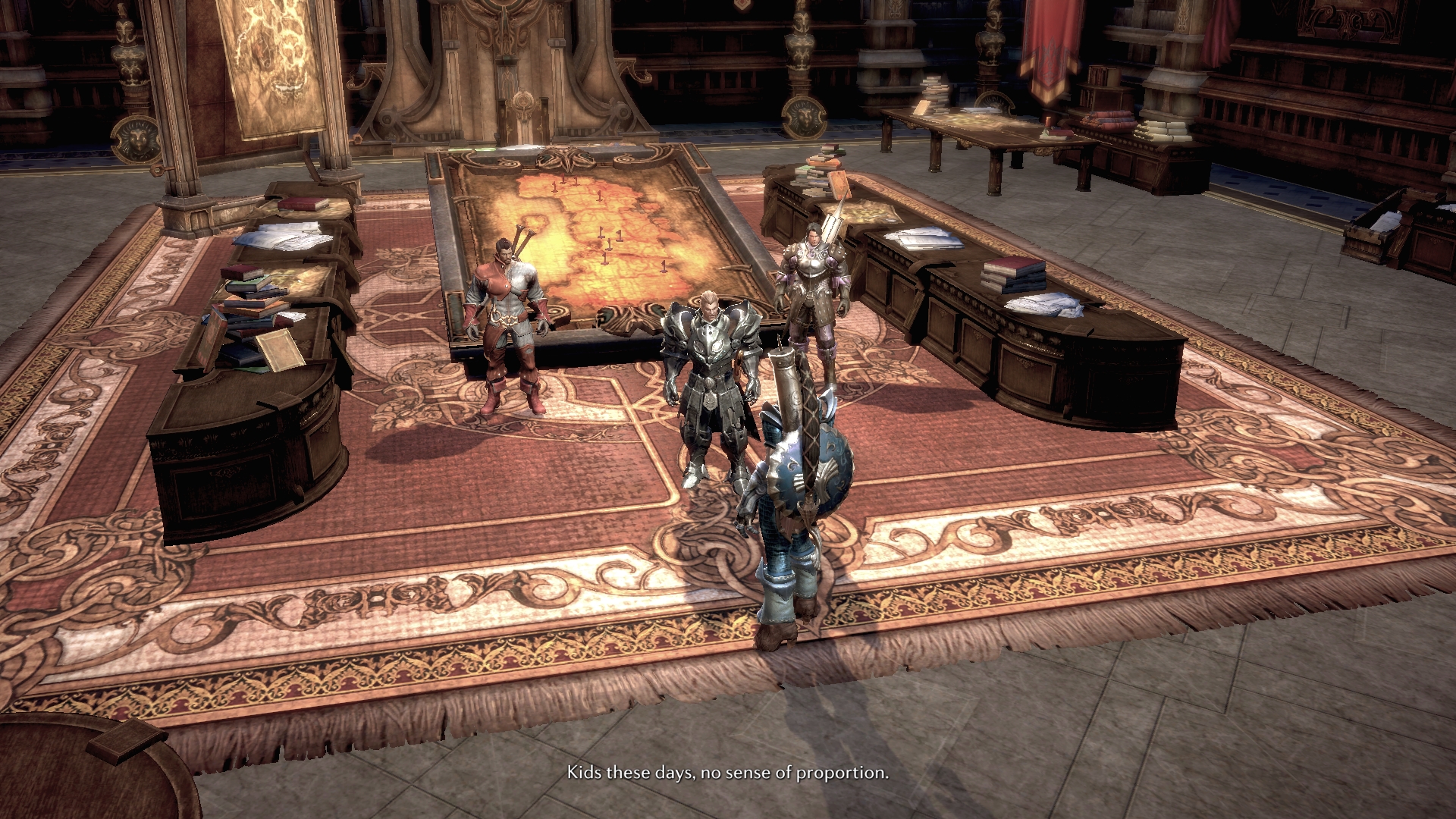
After exploring the city for a while, and claiming my mount (which is granted at level eleven and instant cast – huzzah!), I went to the main hall to speak to the commanders of the war effort there, whereupon after a brief “well done” from the leader, I was palmed off onto a rather brusque and patronising fellow who pointed his sword threateningly at me, and told me not to get cocky after my initial success on the Island of Dawn. I could only look at him in wondrous disbelief, before pointing at my outfit, raising an eyebrow, and querying just whereabouts he imagined I’d be hiding any cockiness. He was lucky he didn’t get an extending lance right in his.

Of course that wasn’t terribly likely to cause him any trouble, because all the men in TERA are pusillanimous braggarts, encased in armour so thick that they reach for a can opener every time they need to pee. Wrapped in their comforting cloak of cowardice, they had the audacity to stand there and tell me that I had no sense of proportion. I told them that my sense of proportion was just fine, and that I had ample evidence of such every time I had to look at myself in a mirror.

I still reckon I could take ’em in a fight.

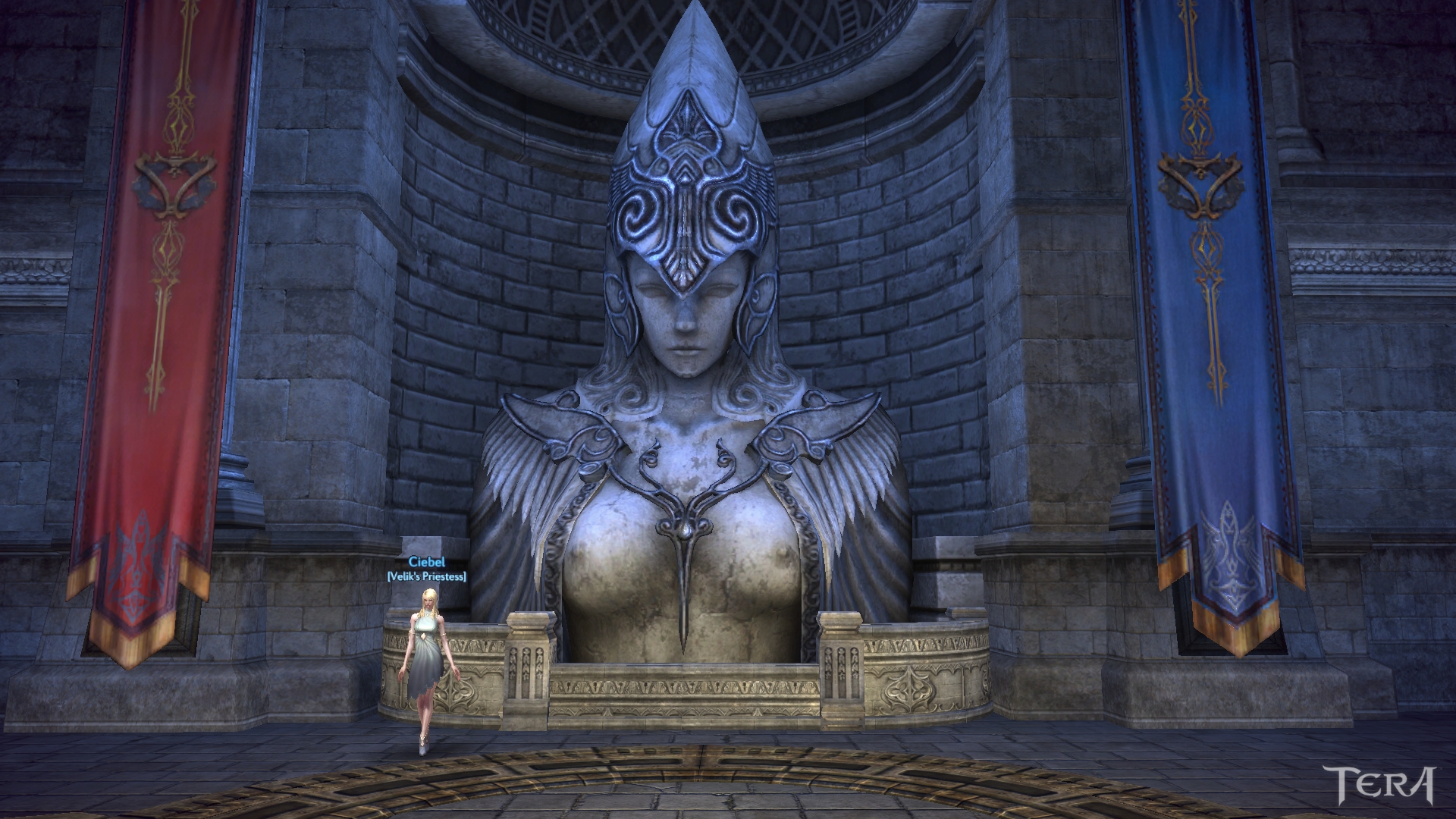
Having left the Keg Brothers to pat each other on their well-armoured backs, I ventured around the city once more. When a world is as beautiful as this, it draws you into the environments and encourages you to observe your surroundings. For example: I met this lovely lady, Ciebel, a priestess, and I couldn’t help but stop to praise her on her choice of outfit. “Finally” I thought, “a place without overt sexualisation of women! Here is this fine young priestess, in a slender yet chaste dress, who clearly has rejected the more lascivious outfits of the warrior caste.” I wandered away in quiet satisfaction, exultant in finding this small sanctuary in the city, where an innocent priestess stands removed from the incessant sexuality prevalent elsewhere in the realm!

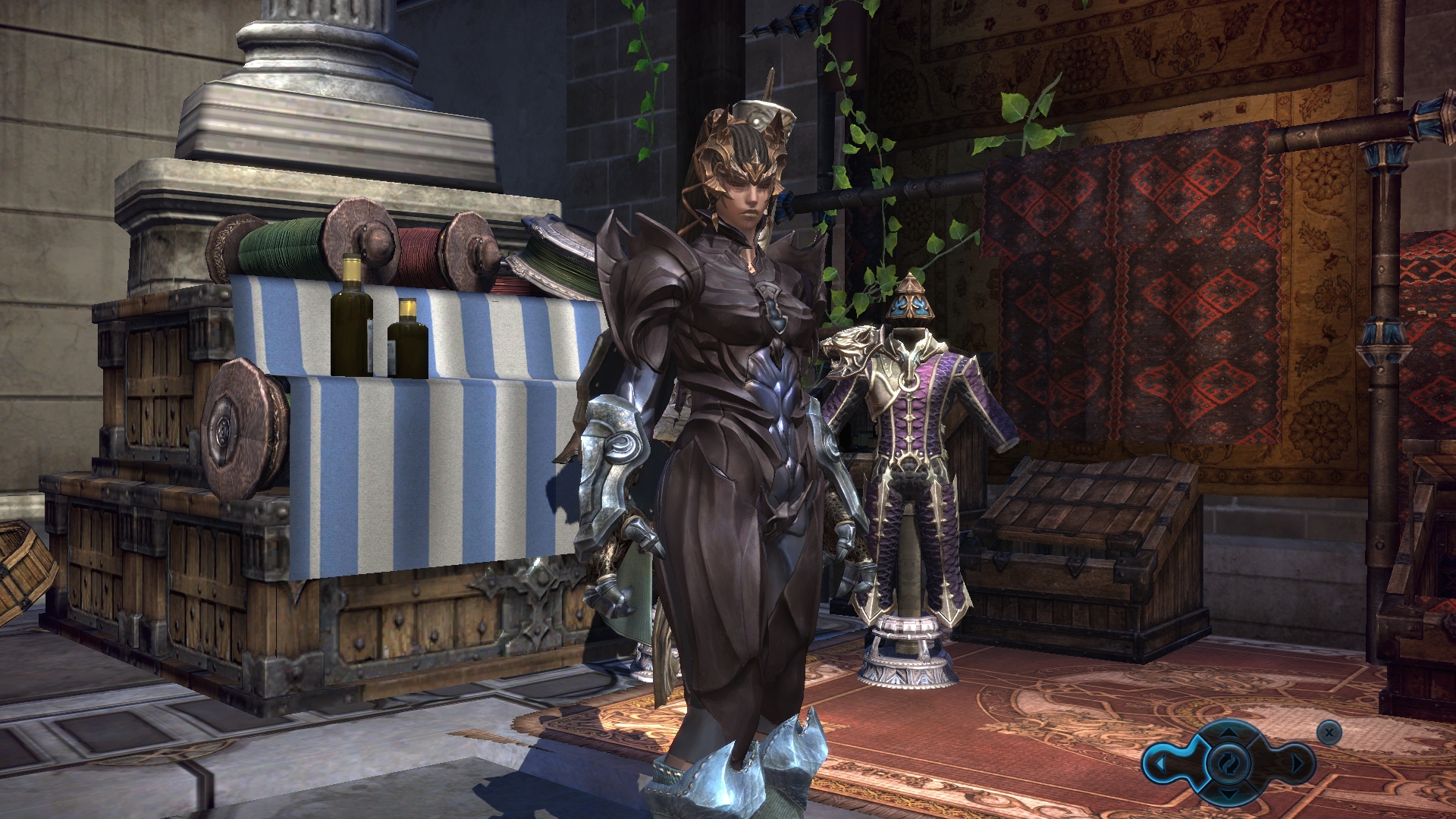
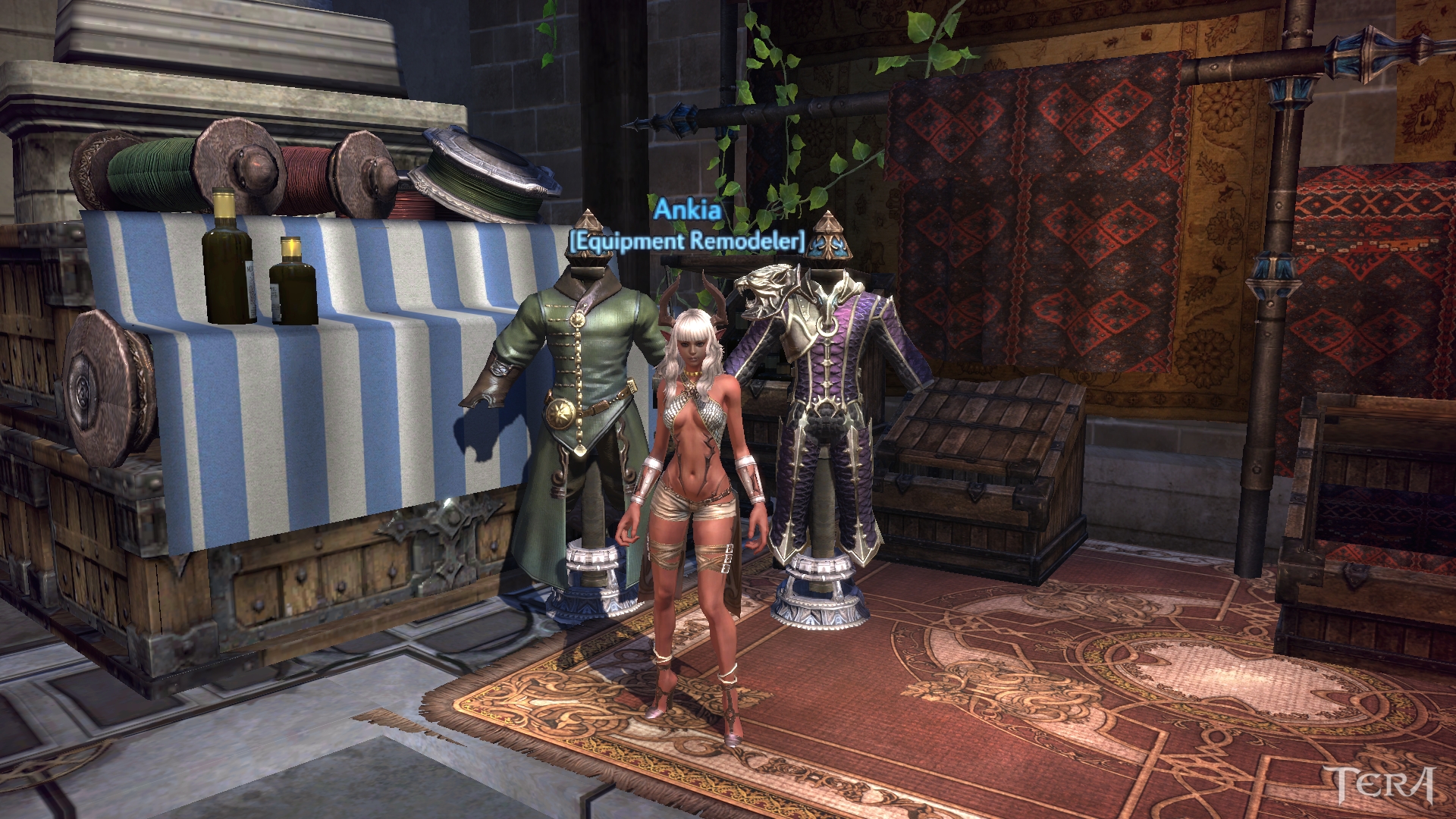
But wait, elation! Joy of joys! In my wanderings I stumbled upon the cosmetic armour vendor. TERA has many cosmetic armour slots, and here I had discovered the Equipment Remodeller, who could offer cosmetic armour items! For a considerable sum of gold, of course. A considerable sum, but one which will be worth every scraped-together-coin, for I had found a set of sensible armour for myself. I could go back to the Keg Brothers and point my lance at them, and say “Hah! Observe how I am appropriately attired for battle and weep, for I could beat you all when I wore but a piece of thin copper wire as a thong, and so now… now I shall be as to a goddess walking amongst mortals!”

So, thank you Equipment Remodeller, thank you from deep within my heavily armoured breast. You are a shining beacon in a world of depravity, and I praise the gods for your presence. In this land where women are forced to wear degrading outfits, you are here with your sense of decorum, your sense of reserve and your sense of dignity. You have fashioned outfits which are tasteful, sensible, and practical. You stand as an example to all, and I would hold you up to all the world as the way that things should really be. Come. Come Equipment Remodeller, come here and let me hold you up, literally upon my shoulder, and I will raise you toward the heavens and rent the air with a cry of exaltation. Come here and… ah. Oh dear. Oh dear me.

Wednesday, 9 May 2012

All the ills of mankind, all the tragic misfortunes that fill the history books, all the political blunders, all the failures of the great leaders have arisen merely from a lack of skill at dancing

Browsing around GAME the other day there were a few boxes of Fallen Earth: Blood Sports for 98p (reduced from £9.99). With Fallen Earth moving to a free-to-play model late last year it didn’t quite qualify for “spot the box for the MMOG that’s closed down“, but I wasn’t sure if the physical game was good for anything more than saving a bit of download time. Displaying the sort of hard-nosed investigative journalistic instinct that’s become a trademark at KiaSA, without thought to my own personal safety I grabbed a box and strode up to the cash desk. If they recognised me as an International Blogger of Blogging conducting hard-hitting undercover research who knows what might have kicked off, so clearly a disguise was in order. Not a problem: I tucked one arm inside my jacket, closed one eye and said “Avast, landlubbers, I am Horatio Nelson, famed admiral and victor of the Battle of Trafalgar, although I was killed during that so obviously it hasn’t happened yet. I’d like this game please.” I was about to hand over my credit card to pay, but at the last second realised it would’ve been a dead giveaway as it had the wrong name on it, so rummaged around and fortunately found a pound coin. “Arr, here be a shiny doubloon to pay for it, me hearty, splice the mainbrace. Yes, put the receipt in the bag please, thanks.”

They didn’t suspect a thing so I made my escape, and got the game installed. Looking at the website it appears to be a fairly standard “freemium” model, and redeeming the code supplied in the case granted 30 days of “Wastelander” premium status with a boost to XP gain etc., usual cost $14.99, so not a waste of a box. I’m not sure if it’s worth stacking up a pile of the boxes, or if you can only apply one of those codes to an account, I’m afraid my unswerving commitment to investigation doesn’t stretch to another 98p.

I can’t make much of an assessment of the game itself as I’m barely out of the tutorial, but it reminds me of Star Wars Galaxies in some ways (not that I ever lasted past a trial in SWG) with FPS-ish ranged combat and lashings of crafting. Like early SWG, Fallen Earth doesn’t have classes; character creation is just about appearance with no worries about too much supermodel perfection in a post-apocalytpic wasteland, plenty of options for scars, wrinkles, facepaint, tattoos and piercings. As you level up you can put points into a mix of stats, skills and mutant powers, a slightly daunting array of options a couple of hours into the game when you’re not really sure how things will develop, like attending a careers fare at infant school:
“So, small child, what sort of field are you thinking about? Lawyer, perhaps? Archaeologist? Lead Senior Direct Corporate Dynamic Future Product Customer Investment Manager?”
“I like painting and running around and Lego and making dens”
“I see, so which A-levels are you considering to further your aims? Art and Physical Education would be natural choices, I’m not sure offhand if there’s a syllabus that focuses on Lego, I’ll need to check up on that.”
“Are there any where you get to be a Flying Robot Wizard?”
“I’ll put down General Studies…”

I figured a bit of research was in order, and a quick poke about on the forums turned up a most helpful Ultimate Guide to Fallen Earth. In the section on levelling it says: “It’s crucial to follow a template because if you don’t you end up impaired and have to buy expensive respecs or even start over.”, with suggestions for builds such as Assault Crafter, Buffer, Debuffer, Hybrid Crafter and Melee Gunner. Seems like, as is often the case, the freedom of a classless system is a vast array of doors spread out in front of you covering all manner of strange and exotic options, where you’re completely free to pick whichever one you want, only it turns out you’re competing in Takeshi’s Castle and only five of the doors lead to freedom, the rest are painted onto solid rock and bruise your shoulder when you try and barge through them.

Classes vs open skills is always fertile ground for debate, and reaching all of level three is no position to render judgement on the system of Fallen Earth. I posted about Pirates of the Burning Sea, how I started out as a Naval Officer and became interesting in the trading/crafting aspect later, but due to the fixed class system had to roll a new character if I wanted to be a Freetrader; I could see a similar path in Fallen Earth, starting out focused on combat then developing crafting skills later on, with skill system giving the flexibility to do that with a single character rather than starting from scratch. With a bit of a lack of gaming time I’m not sure how much I’ll get into it, but then the beauty of free-to-play is that the option is there without having to leave a subscription going; I can be a procrastinator, and have my apocalypse later…

Tuesday, 8 May 2012

You play the hand you're dealt. I think the game's worthwhile.

Sometimes I fear my hands are no longer the natural appendages to my own body with which I was born, but instead have been replaced by sentient creatures with a will of their own. At night they plot and scheme, writing messages to one another and performing complex charades. Then they move my alarm clock so I can’t find it in the morning, before burying themselves beneath me in such a way that I wake up with a dead arm. Attempting to find a wandering alarm clock with a dead arm at five thirty in the morning, while desperately trying not to wake your slumbering partner, is one of life’s more slapstick challenges. With the dull weariness of the recently awoken, your arm flops across to where the alarm clock should be, in order to strike it roughly about the head and silence its infernal chirping. But the alarm clock isn’t where you expect it to be, the realisation of which is replaced by the dawning awareness that you have no real control over your dead arm as it lands on the bedside table with a thunk – the sort of thunk which during the active hours of the day would go entirely without notice, but at silly o’clock in the morning is a thunk to rival the very thunder of the gods. In panic –partly because you’re still half asleep and partly from the innate survival instinct of avoiding death by not waking your partner– you yank your arm back, entirely forgetting you have no control of it, at which point it falls from the sky like a felled tree and strikes you sharply across the face. This has the benefit of waking you up properly. Unfortunately, your natural response to this attack from an unknown assailant is to leap from your bed and prepare to have at it, and thus you push yourself up and swing your legs out of bed with haste. You push yourself up, alas, with an arm that is still entirely unwilling to re-join the great collective adventure that is being a part of your body. As your arm gives way and folds in two, halfway through lifting you up, you can only reflect that this isn’t the sort of immediacy of exit you had planned as your head rebounds off the pillow and strikes the bedside table before following the rest of your body into a heap on the floor, followed shortly by the alarm clock, knocked from its perch, which turns itself off by striking you smartly on the nose.

All of which is to say that my hands are treacherous and work against my will, which conveniently allows me to explain how I ended up purchasing TERA this past weekend and playing it whenever time would allow. I mean, I turn my back for one second, and before I know it my hands are off signing me up for an account and downloading the game. The returns form on En Masse Entertainment’s website did not include an option for ‘Betrayed by evil sentient hand mimics’, so I decided that I would keep the game and see what it was all about.

Perhaps it’s an issue with the MMO model, but it is very easy for me to treat an MMO purchase as I would any single player game. That is, I will spend around £30-£40 and get a game from which I can expect around twenty hours or so of enjoyable game play. If I’m sold on the game after my thirty days of time is up, I can purchase DLC which allows me to continue the story. A single player game can clearly be replayed without further cost, but I can’t kid myself into thinking that I need the option to replay the game: the number of games I’ve ever been bothered to go back and play again, in all my years of gaming, can probably still be counted on my fingers. I see games such as Dragon Age and Skyrim as exceptional value for money, rather than the norm; I’d rather they were the norm, of course, but with the gaming industry such as it is, £1 per hour of entertainment seems to be the median. As such, MMOs don’t look too bad at all based on a box price and a month of play, with the caveats that you need to have the time to dedicate to the game Right Now, and you need to enjoy the sort of gaming experience which MMOs offer, compared to the more tailored experiences you get in games such as Skyrim or Dragon Age. I think this is where Star Wars: The Old Republic gets into trouble: in trying to offer this tailored experience within the framework of an MMO, it seems to struggle to mediate between the limitations of the two styles of gaming experience. SWTOR is clearly a successful game, but is it successful enough to justify the step change in development costs that its genre-hopping entailed?

My initial thoughts on TERA are very much as those that have been reported by sources elsewhere – I don’t think I’ll be in it for the long term, but I’m enjoying the experience so far. TERA’s combat is definitely fun, not a revolution, but certainly more what I’d imagined Guild Wars 2’s combat would feel like, where GW2 actually seemed to lean much further towards the traditional MMO combat style. TERA feels like an advance on DDO’s dynamic combat, and GW2 felt to me like a strange hybrid between Guild Wars and World of Warcraft. Where the environments in TERA are stunningly beautiful, the quest design is just stunning, in the more traditional blow-to-the-head wake-up-in-a-pool-of-blood-with-a-cracking-headache-and-no-idea-who-you-are sort of way. The saving grace, as others have already mentioned, is that the combat is a great deal of fun, so being told to go and Kill Ten Nouns (first MMO to have a creature called a Noun gets five bonus KiaSA points) is not seen by the player as another chore to be done in order to get their pocket experience. Is the combat good enough to carry the entire game? I think that’s where I find I’ll be leaving before too terribly long; as good as the combat is, and as lovely as the world design may be, I need more substance to my RPG. If they’d included more exploration and events akin to Guild Wars 2’s efforts, I could probably be happy that the quest design is so bland, but as it stands I just don’t think that the combat system will carry me through to the end game. Give me TERA’s combat and Guild Wars 2’s… everything else, and I’d probably be a very happy Melmoth, though.

Do I need to comment on the misogynistic treatment of female characters vis-à-vis their ludicrously sexualised outfits? Perhaps this is by design – an attempt to distract players away from the bland and repetitive quests; I imagine players are either so outraged that they find themselves happy to take out their frustrations on the nearest NPC which will accept a hammer to the face, or too busy trying to manage the extreme challenge of playing a complex action combat MMO with only one hand.

I’ll let you know how I’m getting on with the game at a later date, but for the time being I think it will be an interesting filler between my static group night in DDO, and the time Guild Wars 2 comes along and lays waste to my limited free time.

And for the record: if I do happen to find myself playing with only one hand, you can rest assured that it’s entirely an evil ploy by one of my traitorous sentient hand mimics.

Wednesday, 2 May 2012

Fiction is obliged to stick to possibilities, truth isn't

GamesIndustry.biz secure the “Headline of the Day” award for:

“Freddie Flintoff in Nintendo boss rescue”

For gaming readers unfamiliar with cricket, Andrew “Freddie” Flintoff was a fine all-rounder, particularly outstanding in England’s 2005 Ashes win, perhaps as famous for getting into difficulties himself with pedal-based transport.

For cricketing readers unfamiliar with gaming, Nintendo are a large Japanese consumer electronics company who make the Wii games console.

For readers unfamiliar with cricket, gaming, the concept of a “rescue” or the word “in”: welcome to the planet, lupDujHomwIj lubuy’moH gharghmey.

Tuesday, 1 May 2012

And the playground is the optimal milieu for the unfolding of his capacities and talents.

As I mentioned in the comments to a previous post, Guild Wars 2 seems to be a hybrid of questing and exploration, and as m’colleague so splendidly analogised yesterday, Guild Wars 2 seems to fit the bill of being a playground MMO, and this has me rather enthused. The theme park MMOs provide entertainment in a very regimented fashion, with players following the park’s set paths in order to join the queues for rides, where they receive a short infusion of thrill and verve. The sandbox MMO sits at the other end of the scale, providing no direction at all; much like the artist presented with a block of marble, the player in a sandbox MMO generally has to be able to visualise form within the blankness of the medium, and then act upon the medium to realise that form. As it is that many people are not artists, so it is that many players are not amenable to sandbox MMOs, often feeling lost, overwhelmed and daunted.

The playground MMO strives to strike a balance between the two extremes, and this was clearly what the public quests of Warhammer Online and the rifts of Rift were aiming to provide. Guild Wars 2 takes the idea a step further, however, in that each area of the playground has multiple ways in which you can play the game, as Hunter highlighted in a recent post. So, to take the analogy and stretch it somewhat into the realms of sexist stereotypes – the boys run around the climbing frame ‘fort’ shooting each other with pretend guns, while the girls can play field nurses to that same game. Or in MMO terms, the Killers and the Socialisers can inhabit the same area and not necessarily get in each other’s way. Meanwhile, the Explorers can wander around discovering all the various parts of the playground (including that hole in the fence behind the bike sheds), and the Achievers can try to involve themselves in as many games as possible, flitting from one to the other without interfering with the game that is being played at the time.

For the player who wants directed questing, there is the main player story and the scouts who will highlight the Events and Hearts in the area. For the player who just wants to do their own thing, it is quite possible to simply wander around the land and see what one stumbles upon. Guild Wars 2 provides a nice balance between sandbox and theme park. Is it the pinnacle of the playground design? I haven’t played enough of the game to be able to tell. It’s possible that this could be the World of Warcraft of playground MMOs; where WoW took the slightly rough and ready theme park crystal, expertly cut and polished it, until the thing shined and sparkled with multifaceted diamond elegance; time will tell if Guild Wars 2 has managed this with the playground model.

What gives me pause for thought is the apparent lack of support for the fundamental MMO social unit – the adventuring party. Most stark was the difficulty of grouping when the overflow servers were in operation, as though no real thought had been given to the traditional MMO social group. More though, there seemed little incentive to group when undertaking an Event or Heart in Guild Wars 2: players simply went about the objective individually, as a group. Perhaps this is by design, where the open world PvE of the game has taken Rift’s ingenious dynamic grouping mechanic to its ultimate conclusion, such that the people in the playground no longer have to restrict themselves to small select groups of friends, and can instead play together freely with as many or as few people as desired. PvP and dungeon instances are where strict groups will form, but in the open world, new players are simply able to join any game in progress without upsetting the balance of play, and are rewarded according to their contribution to the game. It’s not a new idea, we know of MMOs which have already tried to achieve this with varying levels of success, but ArenaNet seem to have designed their open world PvE game entirely around this concept, rather than trying to crowbar it into the gaps between the more inflexible traditions of the theme park.

So this is what interests me most about Guild Wars 2 at the moment: whether ArenaNet have managed to take the concept of the playground MMO –the attractive hybrid of theme park and sandbox– and made it a reality. If so, it may be the case, looking back some time from now, that we find they indeed didn’t provide the huge step change in game mechanics that some players were expecting, but instead made a huge step change in the entire philosophy of design for this style of MMO. Their manifesto claimed as much, and although I’ve yet to see the conclusive evidence which makes me believe, certainly there are hints that this could be the case. And I do want to believe.

There’s definitely some polishing to be done, but it’s possible that a diamond is hidden here, as yet obscured from view by the raw remnants of the crafter’s careful cuts.